
Red Thread by SoulUp | #3
Measuring outcomes | Why we need more Groups

Last week was weird.
As many of us were still trying to stomach the recent Supreme Court ruling on abortion rights in the US, at SoulUp we wrapped the ‘Going Childfree’ group series just a few days in the wake of that decision. While we concluded a terrific 3 session run with participants brainstorming and reflecting on the decision on whether to have kids - the power, freedom and spirit of this group of people seemed oddly juxtaposed to the apathy with which SCOTUS seemed to have moved.
We intend to publish the feedback from this group soon. But in the meantime, here are some thoughts and snapshots from last fortnight.
On our way to more ‘Group Conversations’
At SoulUp we currently do 2 types of peer conversation (a) 1-on-1 conversations and (b) Group Conversations. The latter is done in small groups of 4-7 people and facilitated by a relevant expert.
Over the past couple of weeks, we have been working hard to shortlist themes and design groups that excite us and which we see a huge need for in the market.
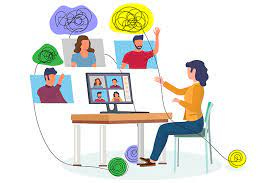
Why we are crazy about Peer Group Conversations:
Being part of a group exposes participants to ‘group intelligence’.
Groups create social accountability and are a great tool to ensure stickiness - thus leading to better outcomes.
May turn out to be cheaper in the long run as compared to therapy.
They are a proven intervention that can be applied to almost any topic. Even things that have huge emotional undertones but are not a usual suspect calling for 1-on-1 therapy.
However, there is a problem. Groups are not the most common thing in India, being practiced in only nooks and crannies of our mental health system. This means:
There are a lot of emotional challenges that can be addressed super well using a group format but like un-addressed (an opportunity for us)
Not many therapists who have enough experience with groups (a barrier we are solving for).
In the coming weeks, we are looking to up our cadence of group launches to 4 groups a month. Can’t wait to finish our homework on this and launch these groups soon! Watch this space for announcements and early bird discounts :)
Measuring Outcomes
There are days we wish, we could just stand on a scale and read a number that tells us how we are feeling. Unfortunately, that does not happen with emotional issues or our mental health. In many situations, the measure could be more subjective that we hope it would be.
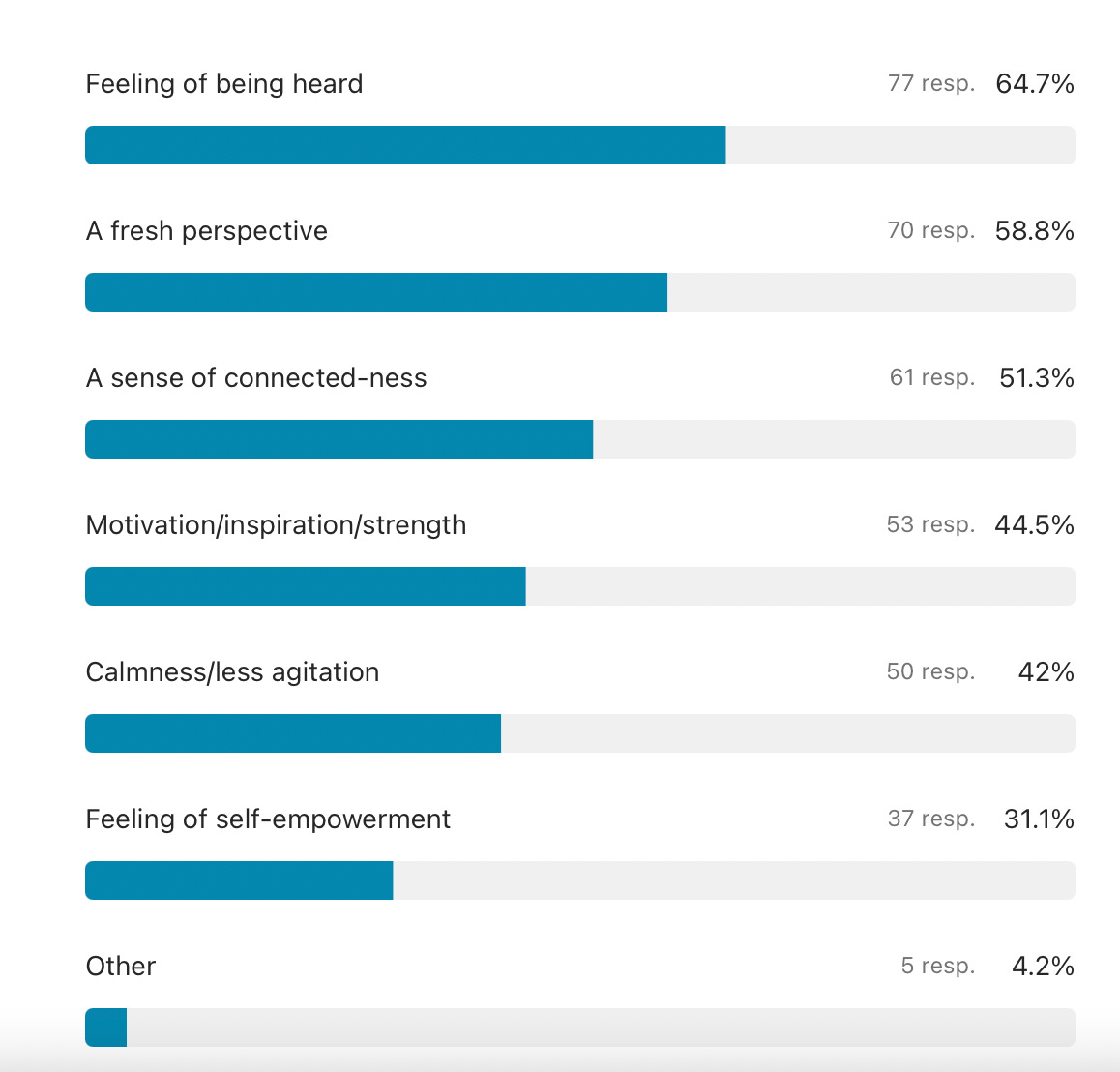
This last week, we have been talking to a lot of experts to develop a more objective and situational measure of outcomes from 1-on-1 SoulUp conversations. We see great feedback from our conversations till date and that has further motivated us to provide our callers with more a more scientific understanding of how powerful and impactful peer conversations have been for them.
Overall rating of SoulUp Conversations: 4.6/5
What 1-on-1 Conversation with a Peer helped users achieve:
A dose of inspiration!
As is customary, here are a few Peer Stories that have inspired us as we finish another week at SoulUp.
My wife had depression and was on daily medication. At first, we were positive that she might overcome it. But soon, we started noticing changes in her and things didn’t seem normal at all. Her behaviour turned from bad to worse and she lost her job. It was getting difficult for us to manage her. She even turned suicidal and I felt more helpless than I have ever been. Seeing her in that condition was scary and broke me from within but I had to be there for her all the time.
She is now doing fine. Taking care of a family member with a mental illness could take a huge toll on one’s mental health. Happy to have conversations with anyone who is struggling with something similar. I’m sure we would be able to share a lot of coping strategies. Book a conversation with Gurpreet here.
***
I was raised by a single parent. Owing to my difficult childhood, I was oversensitive and yet more mature than my peers in quite a few ways. I always felt I wasn’t enough, and considered being raised by a single parent as my weakness. My unhealthy relationship with myself affected my relationship with others in some way.
Years later, when I felt suffocated in an abusive relationship, I gathered the courage to respect myself, and strongly stood by my decisions. I came out of that relationship with a lot of self-awareness and learning. Other than pursuing my career ambitions, I also have a keen interest in psychology and complementary therapeutic modalities and I’m a practicing therapist. Book a conversation with Anuja here.
***
At the age of 13, I was diagnosed with Cerebral Palsy Spastic Diplegia. The biggest challenge for me was to accept my condition and its permanence. Fortunately, I was always surrounded by people like my mother and other loved ones who believed in me and taught me to believe in myself and identify my strengths.
Despite my shortcomings, I’ve learnt to focus on things I can do rather than those I can’t.
I have established myself as a professional writer and a stand-up comedian and I’ll eternally be indebted to those who stood by me over the years. From being a slow writer in school to being paid to write, I have learnt to accept my condition, developed resilience and now make the most of my capabilities. Book a conversation with Rohit here.
***
Like most people, I didn’t really know much about my partner’s past and childhood before getting into a relationship with her. After 2 years of being in a happy relationship, her unresolved childhood traumas and anger resurfaced, which came as a surprise to me. Covid-19 kept us both isolated and separated in our cities, so I couldn’t be physically there for her. Out of her sheer anger and lack of self-love, she committed an act of adultery, to gain love and attention externally. I forgave her but heartbreak crushed me and my spirit.
Today, I am in a way better position and have developed the capacity to listen to others and help them heal by sharing what worked for me. Book a call with Gaurav here.
***
I am from a small town and got married at a very young age. It was an arranged marriage.
Emotional and physical abuse started right after our marriage. I got pregnant after a year. My pregnancy went well but the abuse continued. After a few years of ugly accusations and mental trauma, we were finally divorced. I got custody of my son. Soon, I strove to become financially independent and my family supported me in all ways. My son is now 20 years old and will be graduating soon. He has been the only thing that has kept me sane and given me the strength to fight back.
Book a conversation with Pooja here.
***
My left arm began shaking uncontrollably when I was 6 years old, and I was diagnosed with epilepsy at the age of 10. I had Dystonia symptoms as well, although it wasn't diagnosed until I was 17 years old. I used to run before but now even walking has become painful. I didn’t give up walking because it makes me feel free. I practiced walking each day for 8 months and could now walk without pain.
I’ve managed to be free of epilepsy attacks for the past 2 years.
I know I'm physically limited but my brain functions quite amazingly. I’ve created an online community for people struggling with a disability and regularly share my journey on social media to create awareness of the condition. Book a call with Nisshaa here.
***
I got diagnosed with breast cancer just before my 26th birthday. Tests showed that the cancer was very aggressive - 9/9 on the grading system. I had to get 6 months of chemo, 1 month of radiation, and 5 years of hormonal treatment.
The more difficult part came when all of that was over and I had to pick up my life again. It’s a new normal I had to accept and adjust to. it wasn’t easy, and the process continues. Connecting with a community of survivors online really helped me throughout my journey. I needed someone who understood what it was like to have cancer in your mid-20s. Book a conversation with Megha here.
****
Starting from final year in college, I used to be anxious about my career most of the time and faced sleep disorder. Not being able to sleep on most days turned into sleeplessness. In an attempt to do everything perfectly, I wasn’t even able to get things started. Even though career confusion triggered my sleep disorder, sorting career didn’t really help with sleep. I have tried many ways to sleep and some of them have worked wonders for me. On some days, I still find it hard to sleep but I know how to deal with it. Book a conversation with Alvina here.